Showing posts with label writing. Show all posts

Tuesday, June 18, 2013

Job #483: Proofreader

I got quite a few complaints about errors in some of the digital versions of my earlier books, as mentioned previously.  This was something we tried to put in the hands of professional proofreaders.  That didn't work.  It seems you really need to be the author (and in possession of a good memory as well as a clean hard copy* of the original manuscript) to catch all the errors and not fix things that weren't wrong.

So I'm doing it myself.  And this takes forever.  And because it takes forever I can't do it all at once, or the new book I'm supposed to be writing will never get finished.  I proofread the eBooks in the evenings, after my writing hours.

Not long ago, I did complete the review of Knaves’ Wager.  Eagle-eyed readers will notice that spelling has been Americanized (the attempt at British spelling was a policy of my first, hardcover, publisher), some less-than-felicitous word choices have been corrected, and the scene breaks have been returned.  The OCR errors have all, I trust, been fixed.  Since nobody's perfect, readers may still find an error here and there, but only the normal amount.

What they will not find is a new version of the book.  Even if I had the inclination to go back and rewrite a book I wrote several hundred years ago, I don't have time.  I was proud of what I wrote then; it's impossible to write the same kind of book now that I wrote at a different stage of my life; and I think most readers would rather have the original story.


*Had it been possible to transfer the originals to my hard drive, we wouldn't have had this problem in the first place.

Wednesday, September 5, 2012

We're at Being Geek Chic


My blogging partner author Isabella Bradford* and I are featured on this week's Lady Geek of the Week at Being Geek Chic, "a blog for stylish geeks, sophisticated nerds, tech obsessives, literary hardcores, and those who look for the beauty in life."

Followers of Two Nerdy History Girls are well aware of where our geekdom lies.  But this will be an opportunity to get some of the secret inside info about how we came to be who and what we are.

It's also a great opportunity to discover a blog that's filled with all kinds of fascinating stuff, very much in the spirit of what we do, but about Today, where we're all about Many Yesterdays Ago.

*aka Susan Holloway Scott

Cover of Harper's Magazine, September 1893, Courtesy Library of Congress Prints and Photographs Division Washington, D.C. 20540 USA

What about Lady Clara?

Readers have asked about Lady Clara, who has played a secondary role in my Dressmakers series.

Will she get her own story?
Will she get her happily ever after?

Originally, I'd imagined her story working out over the course of the series.  But the number of enquiries about her future has indicated that this might not be sufficient. Her own book or at least a novella would be sufficient.

Since it takes almost as long to write a novella as it does to write a whole book, I think she's going to get a whole book.  It's going to take some thinking.  But there's time for that.

Right now, I'm still working on Leonie's story.

2013?  I think that will be Lady Clara's year.


Tuesday, February 7, 2012

Happy Birthday, Mr. Dickens

Today, 7 February, is Charles Dickens's 200th birthday.  He was and continues to be my inspiration.  Every year I reread at least one of his books, for the sheer fun of it as well as the re-setting of impossibly high standards.  No matter how many times I reread his stories, I always discover something new.  This was a writer who could give a chair a personality. 

He inspired my love of English history and taught me to love a city I'd never seen—London—and set off that writer's itch that keeps me going and enriches my travels and makes me endlessly curious about the past, especially the world he grew up in and lived in and wrote about.

I am not sure I would have written a single novel, if not for him.

Thank you, Mr. Dickens, for all you've given us & all you've given me.

And a very Happy Birthday to you, wherever you are.

The illustration of a young Charles Dickens (about age 30 if the info is correct), is from Wikipedia—and quite a different look from the more familiar portraits of his older self.

Sunday, October 23, 2011

Everything I Know about Love, I Learned from Romance Novels

Sarah Wendell of Smart Bitches Trashy Books has written another funny, smart, insightful book about romance, Everything I Know about Love, I Learned from Romance Novels.

Some time ago, as she was working on the book, she asked me for my thoughts on romance novels.  I answered, at length...at great length, unsparing, as always, in my exploitation of the English language's massive vocabulary.  I assumed she'd somehow scrape a useful word or two from the flood of prose.

Well, no.  Sarah gave me a whole chapter, titled, "Loretta Chase Pretty Much Knows Everything."  This is kind of funny: When I tell family members the same exact thing, they just laugh.  Sometimes they make rude noises.

Here at her Smart Bitch Sarah page, you can learn more about the book and, since she's making a number of appearances, you may discover an opportunity to hear her fight the good fight for romance in person.

Tuesday, July 5, 2011

A remnant of Northumberland House

The hero of Silk is for Seduction requiring a domicile in Town, I looked around early 19th century London for a little something suitable for a duke.  I'd already moved characters from previous books into St. James's Square, so that was getting crowded.  Where, then?  Berkeley Square?  Nope.  I'd already stuck a family there.  Somewhere overlooking one of the parks? Nice, but none of the houses seemed to suit my hero

Eventually, my real estate search led me to the Strand, a much less fashionable neighborhood.  Once upon a time, (the time of Susan's historical novels, for instance) all the great noble palaces lined the Strand.  By 1835, the area had gone into trade.  But Northumberland House, home of the Duke of Northumberland, remained. 


So I stole—borrowed it, called it Clevedon House, made some architectural and decorative adjustments, and gave it to my hero.

Over at Two Nerdy History Girls, you'll find a post with lots of links to historical information about this fascinating holdover.  It occupies several pages in Christopher Simon Sykes's wonderful Private Palaces:  Life in the Great London Houses.  In London today all that remains is the street named after it, Northumberland Avenue, a doorway carefully preserved in the Victoria and Albert Museum, and a miniature of the room the doorway belonged to, the Glass Drawing Room. 

 Photos courtesy me.


Saturday, March 13, 2010

Last Night's Scandal in glorious purple

Last time I mentioned page proofs.  This is the first pass at the print version, when the book really starts to look like a book, and the author looks for the mistakes she missed, as mentioned in an earlier post, the previous ten thousand times she—not to mention the copy editor and various other editors—went over it.  No matter what, I always find mistakes in the page proofs that can't all be blamed on the printer.  Somehow all those eagle eyes on the manuscript missed, say, missing end quotes.  And then there are the sudden realizations, e.g., "What was I thinking?" or "Didn't anyone notice I used the same word three times in the same paragraph?" or "Wait a minute!  Isn't that an anachronism?" (It usually is.)

I'm happy to report that the page proof phase is now behind me, too, and the next thing I'll see, somewhere down the road, are the Advanced Reading Copies.

Then, before we know it, Last Night's Scandal will actually be on bookstore shelves—while I'm watching Deadline-for-the-next book loom ever larger upon the horizon.

But in the meantime, here for your delectation is the brand-new cover, before even Amazon has it.

Friday, January 29, 2010

Is it done yet?

After the usual frenzy attendant upon my finishing a book, the fifth book of the Carsington trilogy (I know) is now in production.  LAST NIGHT’S SCANDAL follows into adulthood Olivia and Peregrine, the two troublesome children of Book Four, LORD PERFECT. 

The thing with a manuscript is, it keeps coming back, like the undead.  We finish it—we think—and send it to our editors, who send it back for Revisions.  Revisions can involve anything from tweaking a few lines here and there to massive rewrites of less-than-deathless (as in OMG, I can’t believe I wrote that crap) prose.  Then we send it back again and a few weeks later, there it is on our doorstep, this time as a Copy Edit.  The copy editor has gone through the manuscript looking for errors and inconsistencies.  This phase usually requires our Gentle Author to scream quite a bit and bang her head against the wall in frustration.  Then the manuscript goes back with a lot of Stets (for the uninitiated—and you’d do well to stay that way, like a virgin—that means “put it back the way I wrote it”).

Several weeks later, there it is again, on the doorstep.  This time it’s Page Proofs.  But nowadays, thanks to so much being done electronically, this phase is fairly painless and even enjoyable.  We get to see the book the way it’ll look in print.  All we have to do is check for printer’s errors or our own mistakes we somehow missed in the ten thousand times we went over the manuscript already.

I’m not at that phase yet, but I’ll be sure to make a big deal about it when it’s done, because then, really, the book is done.  The next time I see it, it’ll have a cover and everything.

For LAST NIGHT’S SCANDAL, that will happen at the end of July 2010.  Since that’s a long way away, I’ll save talking about the book itself until we get closer to the date.  But for now you have an idea why a book takes so long after I “finish” it to get to the bookstore.

Wednesday, August 19, 2009

Two Nerdy History Girls debut


You may have noticed the new link under My Other Blog.

Susan Holloway Scott & I have joined forces to indulge our historical obsessions.

We've been working on it quietly in the background for a while, but finally decided it's time to spring it on an unsuspecting public.

Michelle Buonfiglio at Romance B(u)y the Book hosts our launch party.

She's got more at her Heart to Heart blog at Barnes & Noble.

It's not too late to stop by and say something.

Wednesday, July 15, 2009

DON'T TEMPT ME: The Interview

Don't Tempt Me sm

Historical fiction author Susan Holloway Scott interviewed me at the Word Wenches blog. Here's how it went, (minus the very flattering intro, which I've edited out because, well, because):

Susan: First, Loretta, what’s it all about? In a nutshell.

Loretta: Zoe Octavia Lexham, a harem captive for twelve years, risks her life to get home to England again, only to find that England’s not wild about having her back. (Here’s English Society’s idea of a harem). The only man who can make Society change its attitude toward her is a childhood friend, the Duke of Marchmont. Handsome, witty, rich, and very, very fashionable, he’s also the laziest man in town and, apparently, not overly intelligent. But he says “Nothing could be simpler” than making her respectable again, and Zoe can’t afford to be picky. And if I say any more, it’s no longer a nutshell but an essay.

Children-Schoolroom-ca-1820 Susan: While Don't Tempt Me is a “stand-alone” book for you, the hero and the heroine are hardly “stand-alone” characters. Their families and friends are very much part of their lives and decisions in both good and bad ways, and yet Zoe Octavia and Lucien de Grey, Duke of Marchmont, are completely separated from their families for years at a time. What role did you see “family” play for both characters?

Portrait of the Benua Family-Olivier-w Loretta: I think family, whether dead or alive, is crucial to character development. We don’t come out of nowhere; we come out of a context. In this story, though, I brought the family up close and personal to the hero and heroine, partly because it’s funny and partly because it’s poignant and partly because of that separation you mentioned. Lucien’s reacted to his experience by becoming detached from everybody. Zoe’s the opposite: She made a family of sorts for herself in the harem and she's determined to be part of her family when she gets back to England. She takes desperate measures to keep from being ejected from the nest--and her refusal to let them eject her is what, eventually, brings Lucien the connection he’s missed. Too, family interactions are a great way to demonstrate character: People behave differently with family than they do with friends, and I loved the opportunities this story gave me to show the comic aspects of aristocrats acting like a normal family.

Harem Bathhouse-Manuscript of the Zanan-nameh by Fazil-Yildiz in the University of Istanbul-w Susan: In your last book Your Scandalous Ways, your heroine Francesca was a genuine, unrepentant courtesan and not simply one as a titillating plot contrivance. In Don't Tempt Me, Zoe has spent nearly half her life in an Egyptian harem, and you don’t sugar-coat that experience, either. How did you research the life of a European woman in a harem? How did it affect Zoe? And how did it make her uniquely ready to conquer London society?

Loretta: I’d learned quite a bit about harems in Egypt while researching Mr. Impossible. This book offered a chance to explore the material further. Zoe’s harem, though, was bigger than the average Egyptian harem--which refers, basically, to the the women of a family. But the more important the man, the bigger the harem. I’d read that Ali Pasha of Albania had three hundred women in his harem. Considering how small Albania was/is, this sounded like half the female population!

Harem reception-Lewis 1873-w This is why my model was the Sultan’s harem, of the Topkapi Palace. With hundreds of women, and all the slaves and eunuchs, things get complicated. I thought a smart, educated young English woman, even at twelve, could adapt and, as she matured in that world, would master its ways. Cruikshank_Loo_in_the_kitchin-wk This experience makes it easy for Zoe to deal with, say, the hierarchy of English society and the hierarchy of household staff.

Pool in a Harem-w Too, in the harem’s hothouse atmosphere, a smart, observant girl would develop a keen understanding of human psychology. The cultural differences are important,too. She’s coming from a world in which people are more demonstrative. Emotion isn’t a dirty word. And dirty words aren’t dirty words: In that world of women, the focus is on sex, and this is what they talk and think about. So she walks and talks and generally behaves differently from English women. It's comedy material, yes, but it's also an eye-opening--and arousing--experience for the men, especially her jaded duke. (For more harem gossip, see my post at the Avon Romance Blog.)


English DukesSusan: The proliferation of dukes in historical romances is epidemic, and for the most part they’re often depicted as pleasure-seeking-slacker-rakes. But Lucien takes his title and responsibilities very seriously––and I have to say it earns him a solid place alongside the other great Loretta Chase heroes. You make him suffer, yes, but he also gets over it, and gets along with his life. Is he based on a real-life peer?


St James Sq 1799-wk Loretta: I stole the Duke of Norfolk’s house for him, and shoved the Duke of Richmond (descendant of Louise de Keroualle, the heroine of your latest, THE FRENCH MISTRESS) down a rung on the ladder of precedence to make room for Marchmont. But he wasn’t based on any duke in particular. I was thinking about what happens to a young man psychically when he’s abruptly thrust, in the most unwelcome circumstances, into a position of great responsibility. I was thinking, “teenager--rebellion--avoidance--denial.”

Gambling at roulette table ca-1800-w But this is also a man strongly influenced by a father figure, Lord Lexham, who takes his public duties seriously and is a devoted family man. That made for a conflict between the outside Marchmont--the detached nobleman who refuses to take anything seriously--and the inside Marchmont, who knows his Duty, and gets it done via his secretary.

Harrietwilson-La coterie debouche As to raking, it seemed to me that a man as detached as Marchmont couldn't be the serial seducer type. He has his 19th C equivalent of girlfriends, but it’s one at a time, for a (short, because he gets bored) time. I wanted us to be aware, all along, of a the kernel of goodness at heart that's necessary in a proper hero--and I think the bond with family helps account for his not turning out all bitter and twisted and selfish. I like to think the sense of humor and the wry self-awareness have grown out of interactions with the Lexham brood.

Almack's_Assembly_Rooms-wk Susan: One of the hallmarks of your books is to establish the setting as a real place, and in Don't Tempt Me you’ve again managed to make early 19th century London seem fresh and vivid. What aspects of the era did you choose to emphasize to make this work?

G-Cruikshank-Inconveniences-Crowded-Drawing-Room-1818-w Loretta: Zoe's point of view helps revive endlessly worked-over ground. She comes to England from another culture, and sees everything so differently. Showing London through her eyes made it fresh. She allowed me to delve more deeply into the old, familiar places. In her eyes, Hyde Park and the Green Park
are wonderlands of greenery. Everything, from the exterior of White’s Club to the claustrophobic royal Drawing Room, is unfamiliar and needs to be interpreted, and her interpretation isn’t like everyone else’s. (The black and white drawing is of the famous Almack's Club.)

Drawing Room at St James's- Microcosm-Rowlandson-w Susan: You’ve always been aware of how fashion and clothes make your characters behave (or not.) The stunningly awkward hoop skirts required for formal court dress play a major part in the courtship been Lucien and Zoe –– and that’s all I’ll say so as not to give too much away. 1778-jeune-dame-de-qualite-en-grande-robe-wki Would you share a little more about these ritualized hoops?

Loretta: Reading about hoops elsewhere had opened my eyes to their seductive possibilities, but then you suggested DANGEROUS LIAISONS--not the Laclos novel but a book published in connection with an exhibition at the Metropolitan Museum of Art. The marvelous illustrations offered the sort of detail one longs for--as well as abundant inspiration. But I think with hoops, the pictures really are worth a thousand words, so I’d direct readers to Candice Hern’s wonderful collection of prints
and I’ll point out that Cruikshank’s comical illustration strikes me as more accurate an illustration of a Drawing Room than the one below it by Rowlandson--certainly it's closer to the one I describe in Don't Tempt Me.

Susan: You've given us three very different Fallen Women so far. What's next?

Loretta: Another Carsington book, featuring a woman of weak moral fiber, a man who prides himself on having no imagination, and a haunted castle in Scotland.

Susan: It seems that's all we're going to get out of her. For more background info, check Loretta's website for links to interviews and blogs.

(Originally posted at Word Wenches)

Wednesday, September 24, 2008

The Angry Apostrophe

Black_lace_barbie

I recently learned that 24 September is National Punctuation Day. In honor of the occasion--which coincides nicely with my recent blogs dealing with Annoying Errors, I thought we could talk about those interesting squigglies and dots and dashes we use to help readers understand what we mean.

In my last blog, I indicated that one way to get a group of authors ranting and raving was to bring up the subject of copy editors. Among other things, a copy editor is supposed to check our punctuation. For some reason, copy edit changes used to disturb me far more than editorial changes. I would go ballistic when a copy editor removed or added a comma, yet not even blink when an editor suggested I delete three chapters.

Virago It must be some kind of mental condition. That would explain why I still twitch when I remember a very weird set of mistakes in at least one volume of Byron’s Letters and Journals. Throughout, it’s was used where its should be and vice versa. It drove me insane.

Yswfrontsm200dpi I know Byron was clueless about punctuation. He admitted it. I know a dash tended to be his universal punctuation tool--but he did dash very dashingly, we must admit. I can understand his failing to master the art of commas, semi-colons, and colons. An apostrophe, however, is sort of a spelling tool, isn’t it? It marks contractions. And he seemed to understand this aspect of punctuation..sort of...or was that his editor? He uses tons of contractions. They appear in practically every piece of his poetry I quoted in Your Scandalous Ways. Here’s a sample from Beppo.

Didst ever see a Gondola? For fear
You should not, I’ll describe it to you exactly:
‘Tis a long cover’d boat that’s common here,
Carved at the prow, built lightly, but compactly;
Row’d by two rowers, each call’d ‘Gondolier,’
It glides along the water looking blackly,
Just like a coffin clapt in a canoe,
Where none can make out what you say or do.

Life_in_london_pg Yes, he had his own unique style but his grammar was fine and his spelling no weirder or more inconsistent than others of his time. It seems bizarre that he got it’s and its backwards consistently. I can’t help thinking those errors were not in the original letters but were committed by a typist, copy editor, or printer and somehow went through the whole production process without anyone realizing--or with everyone thinking that’s how he did it.

I’ve always wondered why it’s and its confuse anybody, but they clearly do because I see it all the time, including in newspapers. Is it because English teachers don’t drum it into kids’ heads early and often enough? It’s one of those things, like the use of lie and lay, that need to be drummed in because it’s easy to get confused. In English we form possessive pronouns differently from the way we form other possessives, e.g., “Pavarotti’s voice was distinctive” but “its engine was broken.”

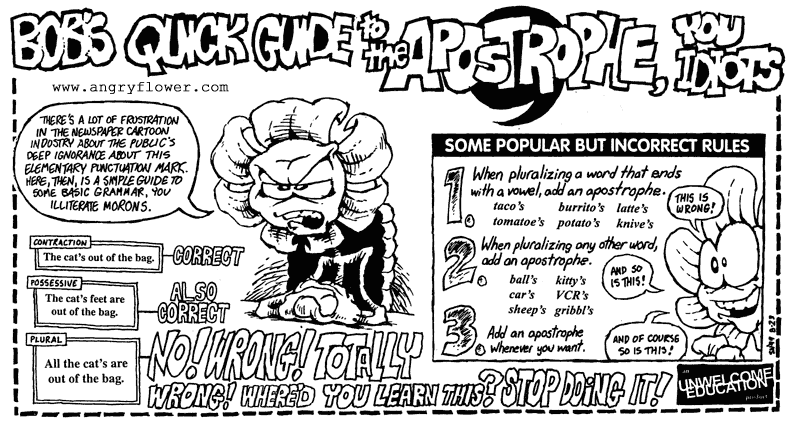
Chicago_manualHowever, while I can--sort of, and with sorrow in my heart--understand how apostrophes get misplaced, I have never figured out how apostrophes got into the plurals business--as in “Banana’s 89¢ a pound” or “keeping up with the Jones’s.”

Here is one approach to explaining the correct way to use apostrophes. Here's a politer version of same. And here are many examples of punctuation abuse.

A few years ago, Lynn Truss got so exasperated with stupid punctuation that she wrote a book, Eats, Shoots and Leaves, about it. Funny thing is, the book’s got some...um...punctuation errors. Louis Menand, in the New Yorker (28 June 2004), reviewed her book, and suspected it was a hoax, because the errors, he said, started in the dedication and continued with gay abandon throughout the book.

In Jasper Fforde’s alternate reality novel, The Eyre Affair, a form of specially engineered bookworms (as in actual larval things, not nerds--and I cannot possibly get into the technical capabilities of these bookworms) excrete apostrophes. That would explain the wretched excess.

Here's one proposed solution to apostrophe atrocities: abolish that little squiggle.

Fowler_the_kings_englishI don’t agree. I’ve devoted my life to the English language, trying to master its intricacies. Punctuation, grammar--all those dull, technical matters to me are part of the big game of exploring the expressive possibilities of a remarkably elastic language. To eradicate a punctuation mark is like eliminating, say, metaphors. Yes, it would make things simpler, but should language always be simple? A straight line is the shortest distance between two points, but it’s not necessarily the most beautiful route.

Merely my opinion, of course, but when the technical niceties of language are under discussion, people can get very...intense. In the words of Randy Newman, "I could be wrong...But I don't think so." And I think he speaks for all of us.

Originally posted at Word Wenches.

Monday, September 8, 2008

Mea Culpa

From Loretta:
Black_lace_barbie

A reader asks:

“I know that once a story is submitted to the editor, it goes through a series of proof-reading and corrections, reworking storylines and editing. Why is it that after all that work some of these mistakes are still found in the story? Do the authors not keep vitals on their characters in order to keep his/her description accurate all through the book?”

It's alarmingly easy for authors to make mistakes. Including really horrendous, ridiculous ones. I speak from experience.

Notes I research the daylights out of my subjects. I keep spreadsheets of character names, physical descriptions, dates of birth, dates of important events, and historical data. I keep a notebook of facts and details I need to check. A phrase in Chapter 2 might be too modern. I’ve changed a character’s hair or eye color or name or age part way through the story. I need to find out where a shop is. I make a note in the notebook and go back to the WIP.

Dictionary_of_the_vulgar_tongueI do this because stopping to correct these kinds of details while in the process of writing disrupts my concentration, mood, and the story’s flow. Because I revise so much while writing, it’s usually better to reserve the detail work for later in the process, when I’m cleaning up the manuscript before submitting it. But sometimes, in the frenzy and exhaustion of Deadline Hell, I miss one of my notes, and the mistake appears in print, to annoy readers like Jaclyne, who wonders how this can happen, when so many pairs of eyes review my work.

Chicago_manual Mistakes with eye or hair color or other vital statistics are the kind someone really ought to catch, same as they ought to catch a writer's using, say, "flaunt" when the correct word is "flout," or a comma where there should be a period, or a missing end quote. If I’m such a babbling idiot by Deadline time as to miss an obvious mistake, a copy editor ought to catch it, and most will. But I’ve never had the same copy editor twice, and as is the case in all professions, some are sharper than others. (Along with covers, the subject of copy editors is one guaranteed to get a group of authors very excited. And not in a good way.)

1817accidentsinquadrilledancing_2 When it comes to historical detail or foreign languages (for Yanks, the latter would include British English), it’s mainly the author’s responsibility. And this author, though a nerd, ALWAYS makes at least one mistake per book. It’s not that I don’t care. I drive myself & others crazy with the obsession to Get It Exactly Right. Yet inevitably, there are errors. Because Nobody’s Perfect. (For the best use ever of this phrase, please see Some Like It Hot.)

Lord_of_scoundrels_07sm_3 ArticlesI could do a whole blog--or several--on the pitfalls of historical research, but foreign languages allow for an easy demonstration of the If You Don't Know It's Wrong, How Do You Know It's Wrong principle.

A few years ago I found out that there were a few errors in the Italian (pronouns and gender errors) in Lord of Scoundrels. This happened despite my consulting books as well as people who spoke and wrote Italian. Trouble was, I did not realize how difficult and complicated Italian was--trickier grammatically than French, for instance. I did not know that the book I relied on was inadequate. Neither I nor my consultants realized my queries to them should have been more detailed. What I needed was an experienced professional translator, but I didn’t know enough to know this.

Americanisms_3

I cannot expect editor and copy editor to catch Americanisms (i.e., words or phrases the English wouldn’t have used) or anachronistic language. So no, I can’t expect them to catch errors in every single foreign language that appears in my books--like Arabic as understood by English speakers in the 19th C (for Mr. Impossible).

Jaclyne says, “It sometimes annoys me to find these in the books I read, thinking that if I found them, they should have been easily corrected in the editing process. It makes me think I should become a proof-reader... seems to me the ones that are supposed to do the job are only skimming the story, not reading it, and so, not doing their job properly.”

That may be a little harsh. True, I and other authors have discovered errors introduced by others during the editing/copyediting/proofreading process--and not corrected, despite our protests. We’ve also discovered mistakes that every single person reviewing the manuscript somehow overlooked. But we definitely can't expect those reviewing to be omniscient. We’ve all made mistakes, I think, for which we can blame no one but ourselves, and all we can say to readers is, Mea Culpa.
Criminal

(Originally posted at Word Wenches)